
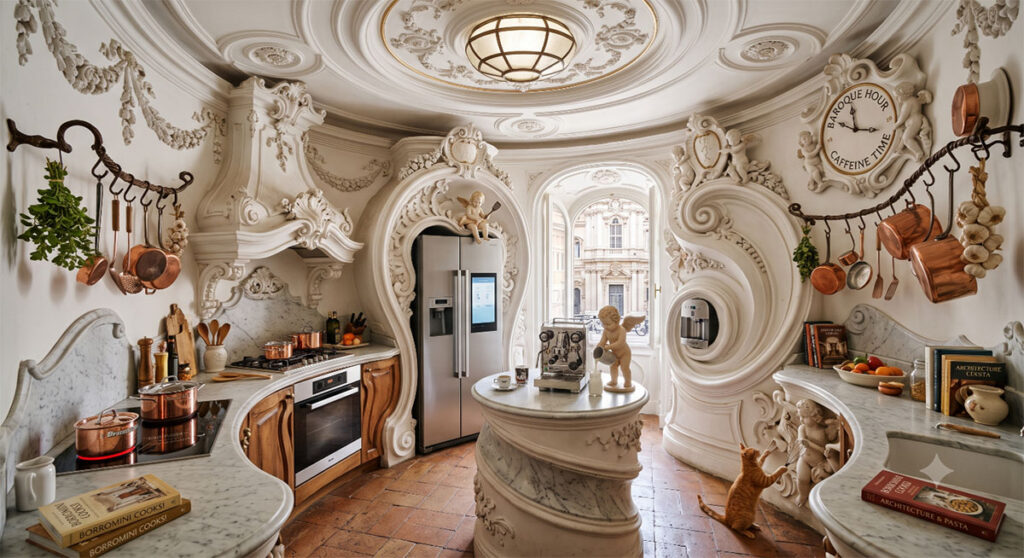
How many times have you heard the lament, “Francesco Borromini designed my kitchen, so what do I do now?” If you’re like me and born after the 17th century, the answer is zero. But maybe it happened. Strange pairings of architect and project are everywhere.
But first, who was this crazy kitchen designer, and how did I find him? Well, you may be surprised to learn that Francesco Borromini didn’t design kitchens. He was also a very famous architect – perhaps the greatest architect ever.
The architecture of Francesco Borromini (1599-1667) is among the finest of the Roman Baroque Period. His work appears willful, hedonistic, and wrought with emotion but, in fact, it is borne of fanatically analytical, rational, and profound means, firmly rooted in the works of Michelangelo and the ancient Romans. Where most people might separate emotion and reason, tradition and innovation, art and technology, Borromini sought to integrate these competing concepts. He achieved willful movement through static geometries, futuristic invention by historical precedent, opulent richness through restrained order, and passionate design through coldly analytical means. His iconic works, such as San Carlo alle Quattro Fontane and Sant’Ivo alla Sapienza in Rome sought a higher order through integration rather than juxtaposition of the components of his society.
Unfortunately, while his work revolutionized architecture, it is unlikely that he would be much good at designing a useable kitchen. His working triangle would be a decahedron. Moreover, he was melancholic and quick tempered. Supposedly, he even had a stone mason on his jobsite killed for poor workmanship. As brilliant an architect as he was in almost all respects, Borromini would not have been not the best choice for a kitchen, a bathroom or any residential remodeling project.
So how exactly does one pick “the best” architect, contractor, interior designer, etc. and what does “best” even mean? Selecting the best architect for your project is not as simple as reviewing relevant experience. It also requires clear thinking about your goals, your values, your own weaknesses and strengths as well as budget and schedule. It mean’s selecting the best fit for the specific project at hand.
How do we figure this out? Here are some questions you should ask yourself before selecting your architects:
- What are my goals for the project? Not just a list of rooms, but what change do you hope to achieve or what problem(s) are you trying to solve? For example, instead of asking for a kitchen of a certain size, ask how food is prepared. Is it a joy or a chore? Is food prep a social experience? Do you need separation from the kids or would leaving them alone as you cook result in a Pieter Breugal (the Elder) scene, to continue artistic analogies (Maybe too forced – trying to tie the intro content and tone into the second half a bit – JL)? Do you eat meals as a family or is it mostly grab-and-go? Do you need flexibility for large gatherings?
- What is my timeline (not your schedule)? Are you solving yesterday’s problems or planning 5, 10, or 20 years out? For example, are you adding bedrooms that toddlers need right now or planning for adolescents and teens? Is aging in place important or is this a transitional house?
- What are my priorities for this project? Since you inevitably won’t get all that you want (unless you have an incredibly short list, or an inconceivably large budget), what are your priorities? Can you sort nice-to-haves from deal breakers? Think about morning sunlight, trees you refuse to remove, privacy from neighbors, or views you want to capture. If (or when!) you are over budget, will you increase the budget or reduce the project size? Try asking yourself, “If I can’t have these three things, I will cancel the project.” What do I value most about the physical property or building?
- What do I value most (not in your life, just in the project)? There is an axiom when selecting a contractor that you you should consider cost, schedule and quality, then pick two. Do you value originality over tested solutions? Do you consider code compliance essential vs bending the rules and pushing the building code envelope? Are you seeking an architect who everyone will recognize or the comfort of one recommended by friends and colleagues? When your project is complete, do you hope to feel surprise or relief?
- What are my strengths and weaknesses? Where can you add value to the project besides just writing checks. For example, you may be a master of budgeting and scheduling, or an expert in color selection. If so, these qualities will be a lower priority in selecting an architect. Conversely, you may feel you need extra help with material selections, 3D visualization or controlling costs, and you should look for an architect with strengths in these areas. How decisive are you under pressure? If this is a weakness, are you looking for a more decisive architect to drive decisions? If this is a strength, do you want an architect to help you slow down and see all sides of an issue? The goal is to select an architect who complements your strengths and weaknesses rather than mimicking them.
- What is my true project budget? Include construction, fees, furnishings, financing, temporary rentals and a healthy 15-20% contingency. You should be prepared to spend all of it and be happy if you don’t.
- Who will make decisions and for what? Whether your team includes a spouse, a partner, or a loan officer, establishing who has ultimate authority over what when disagreements inevitably occur smooths the entire experience, saves time and money, and mitigates or forestalls expensive Hundreds of decisions—from window mullion profiles to outlet placements—must be made on tight deadlines once construction starts. Establishing some decision protocols helps.
- Am I really ready? A successful project begins with a very long leap of faith. Are you ready to trust the architect (and the engineers, and eventually the contractor)? You hire an architect for problem solving and spatial expertise, for their ability to consider light, flow, composition, structure and function. Are you truly open to solutions you haven’t conceived yourself? And are you ready to have your patience tested? Depending on scope and location, getting from first designs to a permit may be 15 months or more. Then, construction can be over a year long. Are you ready for this 3+ year “marriage of convenience”? As you interview architects, consider that this is not a short term task but a long term professional relationship.
In the end, the “best” architect for your project isn’t necessarily the big name, the closest office, or the architect that was perfect for a friend or another member of your family. The “best” architect is the person or firm who understands your goals and requirements, shares your values, and complements your strengths and fills in for your weaknesses. And even if he was alive today, it would still not be Francesco Borromini.